Rampart Preview featuring Melissa Weber
The Ella Project is excited for the upcoming release of Rampart: A Musicians Guide to Estate Planning and Readiness, our first publication coming out in 2026. Here’s a preview of Rampart, The ins and outs of donating to archives, explained by Melissa Weber, curator with Tulane University Special Collections
By Jann Darsie
The Hogan Archive of New Orleans Music and New Orleans Jazz, a unit of Tulane University Special Collections (TUSC), allows music lovers and researchers to take a deep dive into the city’s rich musical and cultural history.
Melissa A. Weber, curator for the Hogan Archive, sat down with the Ella Project to explain what are archives and how personal materials can be donated for preservation. Although the Hogan Archive concentrates on New Orleans music, most of these guidelines apply to other archives as well.
Weber also provided guidance for those who want to preserve documents and other materials for posterity, whether for a family archive or an archives repository at an institution, such as TUSC.
An admirer of the Ella Project, Weber had this to say about its connection to archives: “In archival practice, we have a duty to uphold both responsible stewardship and the intellectual property rights connected to cultural primary source materials.
“I deeply value how the Ella Project equips artists and culture bearers with the knowledge and tools to navigate these complex issues, ensuring that their legacies and stories can ethically and responsibly support public access and long-term preservation in archives.”
So what is an archive? The dictionary definition is a collection of materials with enduring value preserved for long-term reference. Archivists preserve original source materials such as interviews, historical records, personal papers, business papers, photographs, sheet music, letters, ephemera, audio/visual recordings, and other materials.
Weber added that archives contain permanently valuable materials that reflect the people and culture within an era. TUSC holds, for example, audio interviews writer Laurraine Goreau recorded from 1971 to 1975 during her research into the life of Mahalia Jackson for her 1975 authorized biography of Jackson, “Just Mahalia, Baby.”
These are not just famous people’s materials. “Everyone’s stories are important and speak to our history and culture,” Weber said.
There are several benefits to donating materials to an archive. “It can help ensure the preservation of history for future generations,” said Weber, adding that we can all learn from the past. Donations also preserve a person’s or a family’s legacy. And they become a valuable research tool for understanding and honoring the past through first-hand accounts.
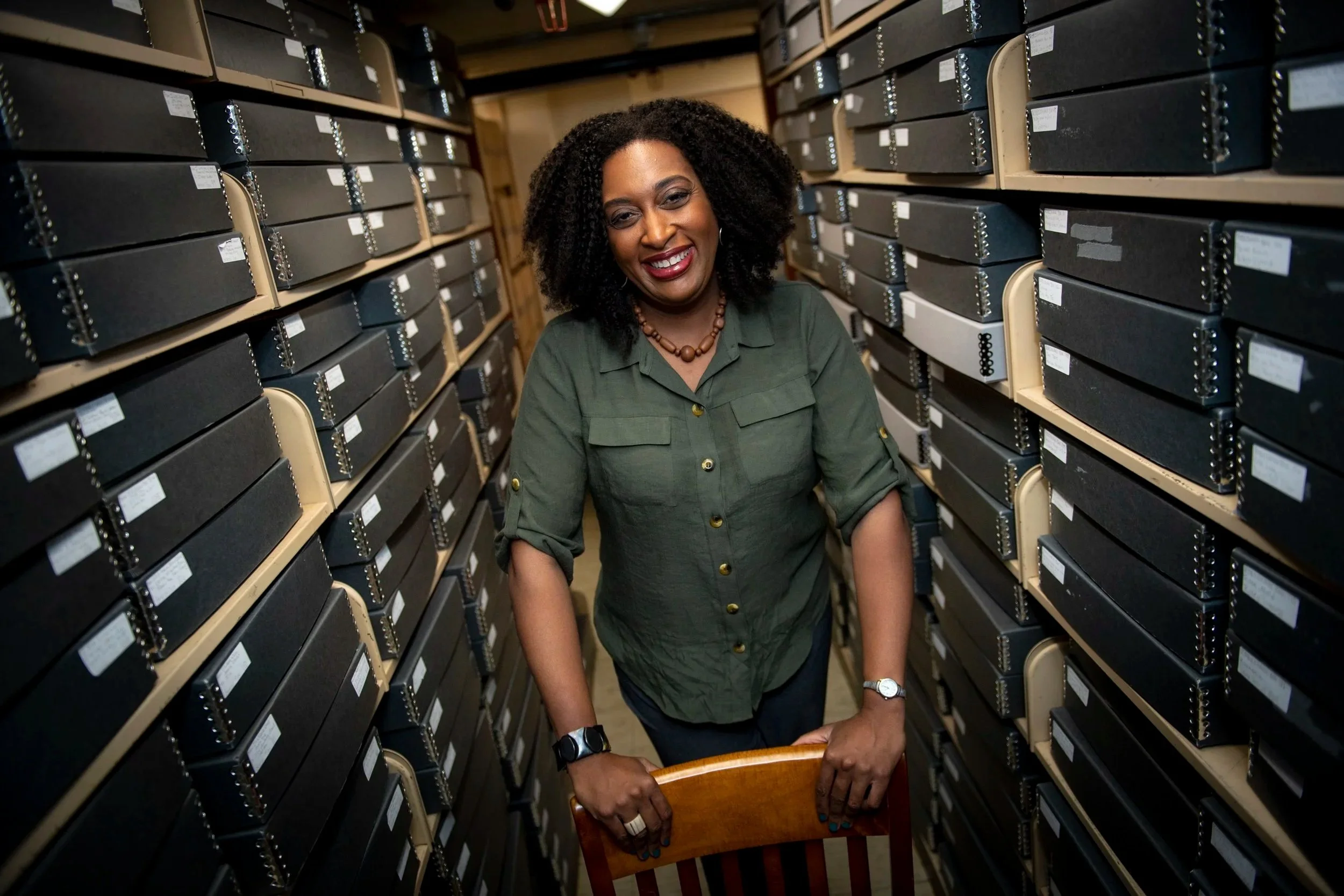
Melissa Weber in the Archives. Photo by Paula Burch-Celentano
What types of materials are archives looking to have donated? Each archives repository is different. TUSC primarily accepts paper-based items such as business or personal papers, correspondence, memorabilia and other ephemera, and non-commercially available audio or video recordings such as field recordings, interviews, home movies, or personally recorded events.
In the specific case of the Hogan Archive at TUSC, Weber explains that the material should fit their collection policy. Their curatorial vision focuses on the history, culture and community of New Orleans jazz, rhythm and blues, gospel, blues, ragtime, Creole songs, and related musical genres. For example, the archive contains the papers of trumpeter and bandleader Louis Prima, a New Orleans native known for lively swing and jump blues tunes.
How does one choose the right repository? Each archive will have its own collection development policy, so it begins with research and a phone call to find out whether a potential donation is the right fit.
“You can do your research by looking at various archives repositories in town, such as TUSC, Amistad Research Center, and Historic New Orleans Collection to name a few. Contact them to see if they may be interested in your materials or collection. If they’re not interested, it’s not that your collection is not worthy. It may not align with the repository’s collection development policy or other objectives,” Weber explains.
“You may also be interested in inquiring with archives out of state, such as the Archives of African American Music and Culture at Indiana University, the Archive of Contemporary Music in NYC, the Archive of Popular American Music at UCLA Special Collections, or the Rock & Roll Hall of Fame Archives in Cleveland. I try to encourage people to consider keeping their New Orleans-related collections here at home, but the possibilities are endless. The important thing to remember is that wherever it is located, once a collection is processed, it is accessible to everyone regardless of where they come from.”
Weber also adds that, when planning an estate and writing a will, anyone with materials they’re interested in donating to an institutional archives repository should make sure they are a fit before finalizing their disposition.
Some individuals may prefer to retain their materials within their family or preserve their history privately, maintaining a personal archive rather than transferring them to an institution. Tulane Special Collections has provided instructions from preservation experts for anyone wanting to personally preserve their photos, letters and other documents so that their family and community history can live on.
Whether materials are donated to an archive or used to create a private collection, the steps to organizing the items are the same. “Inventory and label,” Weber said more than once. One starts by creating an inventory. “It is important to keep things in their original order,” said Weber.
And when labeling any items, never use a pen. Always use a pencil and write lightly. So for example, on the back of a photograph or a poster write so lightly that it does not make a ridge on the image.
Detail as much information as you know about the materials: the date, the people involved and the context.
The Hogan Archive at TUSC welcomes materials from local musicians. What is the single-most helpful thing musicians can do to preserve their items for eventual donation? Again, Weber said “inventory and label with brief descriptions and approximate dates. Create and maintain a simple inventory of what you have, and keep it labeled, organized, and understandable to someone else. Well-organized and well-described materials help archivists accurately preserve materials and empower your legacy.”
TUSC is a public archive accessible to everyone, and one doesn’t have to be affiliated with Tulane University to use or access its collections. People can use archives for research purposes, educational goals or simply personal enrichment. Unlike museums, however, visitors to an archives repository must schedule a reading room appointment. When visiting museums, visitors only see what is on display. In the case of archives, visitors must request what they wish to view or study and the items are selected and presented by advance arrangement. While materials at an archives repository aren’t on display, all processed collections are accessible for viewing at any time of the year.
Unlike many archivists, Weber did not receive a Master of Library of Information Science (MLIS), which is the advanced degree generally required for archivists. However, she supplemented her expansive knowledge of New Orleans music with accelerated training and continuing professional development in archival theory and practice, required in the field. Prior to working at TUSC, she worked at Tulane as program manager overseeing undergraduate cocurricular grants and a jazz concert series. And she has long been personally involved in the music and culture of her native city.
Weber has published widely and has presented papers at academic conferences including for the American Musicological Society, International Association for the Study of Popular Music, National Council for Black Studies and Society for Ethnomusicology, among others.
“My mother is the first archivist I knew, though she never called herself an archivist and had no idea what she was doing was archiving,” Weber said. “I now have a personal collection because of her and I picked up my love of documenting and collecting primary sources from her.”
When she joined the TUSC staff, her love of personal archives was formalized with rules, codes and responsibilities of archival preservation. “There are ethics and standards specific to archives, and I am honored to adhere to them in my work,” Weber added.
For more information about the Hogan Archive of New Orleans Music and New Orleans Jazz and Tulane University Special Collections visit https://library.tulane.edu/tusc.
Rampart is supported by a grant from the Emily Hall Tremaine Foundation. Additional funding from a grant from the Louisiana Division of the Arts, Office of Cultural Development, Department of Culture, Recreation and Tourism, in cooperation with the Louisiana State Arts Council, as administered by Arts New Orleans. Funding has also been provided by the National Endowment of the Arts.